
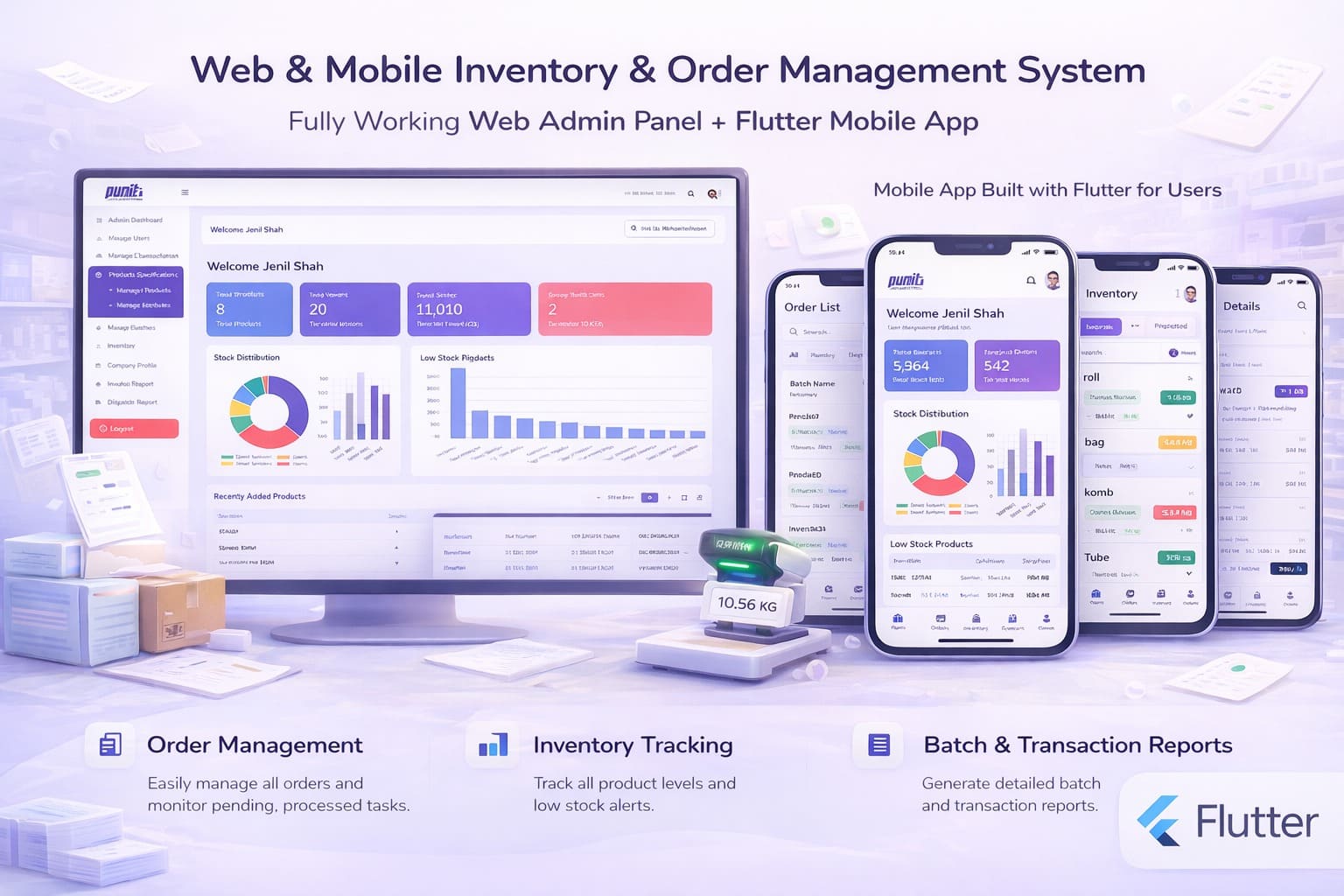
Warehouse Management System: Enterprise-Grade Inventory & Operations Platform
A comprehensive platform that transforms chaotic warehouse operations into streamlined, automated workflows using a powerful web admin panel and a mobile-first field app.
Warehouse operations are the backbone of logistics, manufacturing, and distribution businesses. Yet most warehouses still rely on spreadsheets, manual entry, and fragmented systems. Inaccurate inventory, slow dispatch, lost products, and inefficient workflows cost businesses thousands daily.
We developed a Warehouse Management System (WMS) that delivers real-time visibility, eliminates manual errors, and enables warehouse teams to work faster and smarter by bringing precision weight tracking and multi-location coordination into one seamless platform.
The Warehouse Challenge
Modern warehouse operations are complex. Products flow constantly: inbound from suppliers, stored in inventory, picked for orders, packed, and dispatched. Every step requires accuracy. A single error cascades through the system.
Weight-Based Inventory Complexity: Unlike standard unit-based inventory, tracking in kilograms requires precision. Small weighing errors compound across batches. The system must integrate with physical scale hardware.
Multi-Location Coordination: Tracking products across receiving areas, storage zones, and dispatch bays manually is slow and error-prone.
Batch & Transaction Records: Every movement must be logged. Complete audit trails are essential for compliance and problem-solving.
Staff Workflow Optimization: Warehouse staff need fast, intuitive tools. Complex interfaces slow high-volume operations.
Real-Time Visibility: Delayed reporting prevents responsive decision-making. Managers need live visibility into bottlenecks.
Our Strategic Approach
Discovery & Workflow Analysis
We spent time on the warehouse floor observing operations rather than making assumptions. This grounded approach ensured every feature was built around actual workflows:
- How products are received and checked in
- How inventory is stored and organized
- How orders are picked and packed
- How dispatch works and what information is needed
- Identifying bottlenecks and frequent manual errors
Dual Platform Strategy
Web Admin Panel: For managers and administrators. Feature-rich, detailed dashboards for analysis, configuration, and top-down control.
Flutter Mobile App: For floor staff. Optimized for speed and minimal friction. Large touch targets, barcode scanning, offline capability, and direct hardware integration.
Weight-Based Inventory Architecture
Tracking by weight rather than units required a custom approach:
- Scale Integration: Mobile app connects via Bluetooth to industrial weight machines to eliminate manual entry errors.
- Precision Tracking: Configurable decimal precision to prevent rounding errors across batches.
- Batch Management: Complete weight history isolated by product batches.
- Variance Handling: Automated flagging for natural loss or measurement differences requiring reconciliation.
Key Features & Capabilities
Product & Inventory Management
Product Setup & KG-Tracking: Complete catalog control with variant support. Real-time inventory displayed in kilograms with historical movement records and low-stock alerts.
Multi-Location Support: Easily transfer products between receiving, storage, and dispatch zones.
Inbound & Outbound Operations
Inward Entry: Receive shipments, capture supplier info, perform quality checks, and record weights automatically via Bluetooth scales. Generate scannable barcode labels instantly.
Dispatch & Returns: Mobile-guided order fulfillment, weight verification at dispatch, and structured workflows for returned products and restocking decisions.
Hardware & Infrastructure
Hardware Integration: Direct connections to Bluetooth weight machines, thermal printers, and standard barcode scanners.
Multi-Tenant Architecture: Secure, isolated data environments for businesses managing multiple warehouses or subsidiaries.
Access & Auditing: Granular role-based access control paired with comprehensive transaction logs and performance dashboards.
Technical Specifications
- Frontend (Admin): React.js, Redux, Material-UI, WebSocket for real-time updates
- Mobile App: Flutter, Dart, SQLite (Offline-first), Bluetooth serial connectivity
- Backend: Node.js, Express.js, PostgreSQL, Redis caching, RabbitMQ message queues
- Infrastructure: Docker, Kubernetes, AWS/GCP cloud deployment
- Performance: Sub-second response times, background sync ensures operations survive connectivity loss
- Security: JWT authentication, encryption at rest/transit, row-level multi-tenant isolation
Business Impact
Challenges Overcome
- Bluetooth Scale Complexity: Built a flexible integration layer supporting multiple industrial scale models and protocols.
- Offline Operations Sync: Developed an offline-first architecture with a robust transaction queue and conflict resolution to survive poor warehouse Wi-Fi.
- Weight Variance: Implemented configurable variance thresholds to handle natural product loss without creating false alarms.
- Multi-Tenant Isolation: Applied database-level row isolation to ensure secure SaaS operation for multiple companies.
- Real-Time Scalability: Utilized RabbitMQ and Redis to ensure live updates don't degrade under high transaction volumes.
Services & Technologies
Industry: Logistics / Warehouse Management
Platform: React Web Admin & Flutter Mobile App
Stack: React, Node.js, PostgreSQL, Flutter, RabbitMQ, Redis
Services: Full-Stack Dev, Hardware Integration, Cloud Infrastructure
Integrations: Bluetooth Scales, Barcode Scanners, Thermal Printers, AWS
What's Next for the WMS
Future enhancements being planned include:
- AI-powered demand forecasting for inventory optimization
- Predictive analytics for maintenance alerts
- Integration with major e-commerce platforms for order automation
- Advanced picking optimization algorithms
- Mobile app for customer tracking (shipment visibility)
- Analytics for warehouse efficiency benchmarking
Conclusion
Warehouse Management Systems are the nervous system of logistics operations. A well-designed system eliminates errors, accelerates operations, and provides the visibility needed for responsive management. By combining enterprise-grade backend architecture with mobile-first field operations, this WMS delivers the accuracy, speed, and scalability modern warehouses require.
This is more than software. It's operational transformation—transforming chaotic manual processes into streamlined, automated workflows that drive efficiency, accuracy, and growth.